
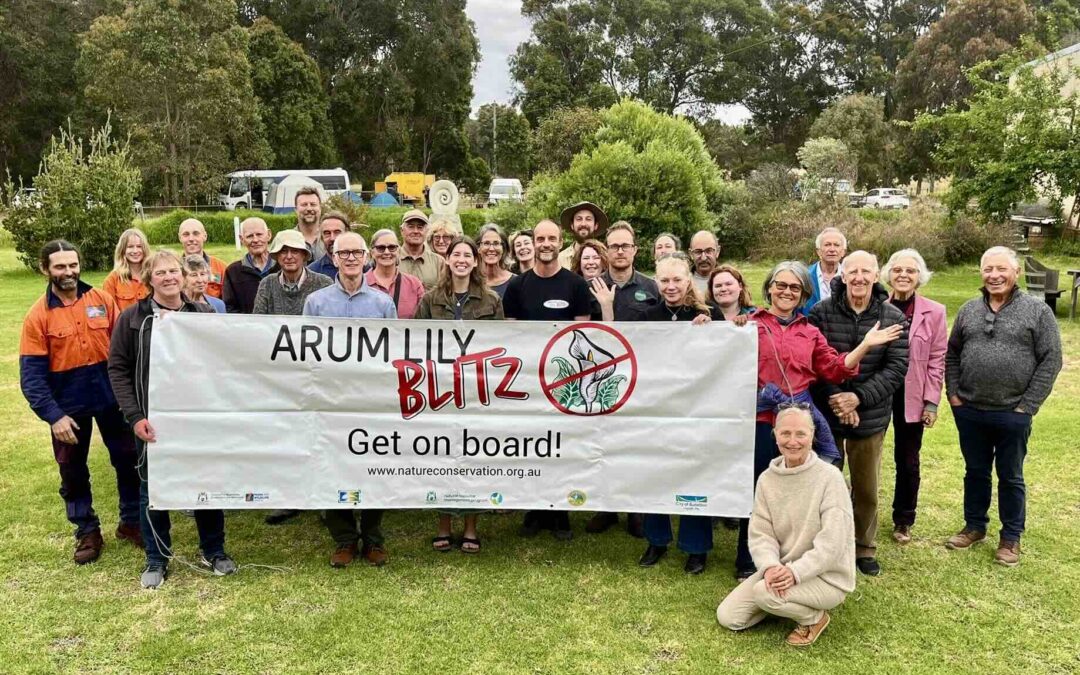
Nature Conservation Margaret River Region’s Arum Lily Blitz has wrapped up for 2025, and it’s been another record-breaking year, with major new inroads made against the region’s worst invasive weed.
The Blitz team set out to identify and reach new high-priority landholders in key areas across the Margaret River region, particularly those adjacent to the national park, remnant bushland and neighbouring properties where significant investment has been made. They pulled out all the stops from cold calling; letter mail outs to door knocking.
As a result, twenty new landholders were supported through the cost-share control program — many of whom had never controlled arum lily before — helping to close crucial gaps in the landscape and expand the impact of the program.
The Blitz also delivered a record-breaking year for herbicide distribution, with 760 bottles of highly targeted arum lily herbicide handed out through participating outlets. M&B Dunsborough Rural Supplies once again led the charge as the biggest distributor, reflecting the City of Busselton’s growing commitment to arum lily control across its patch.
Caves Road received renewed focus too, with Nature Conservation’s Blitz officers Obelia Walker and Ben Howell mapping priority sections from Redgate to Yallingup and coordinating strategic control by Main Roads WA.
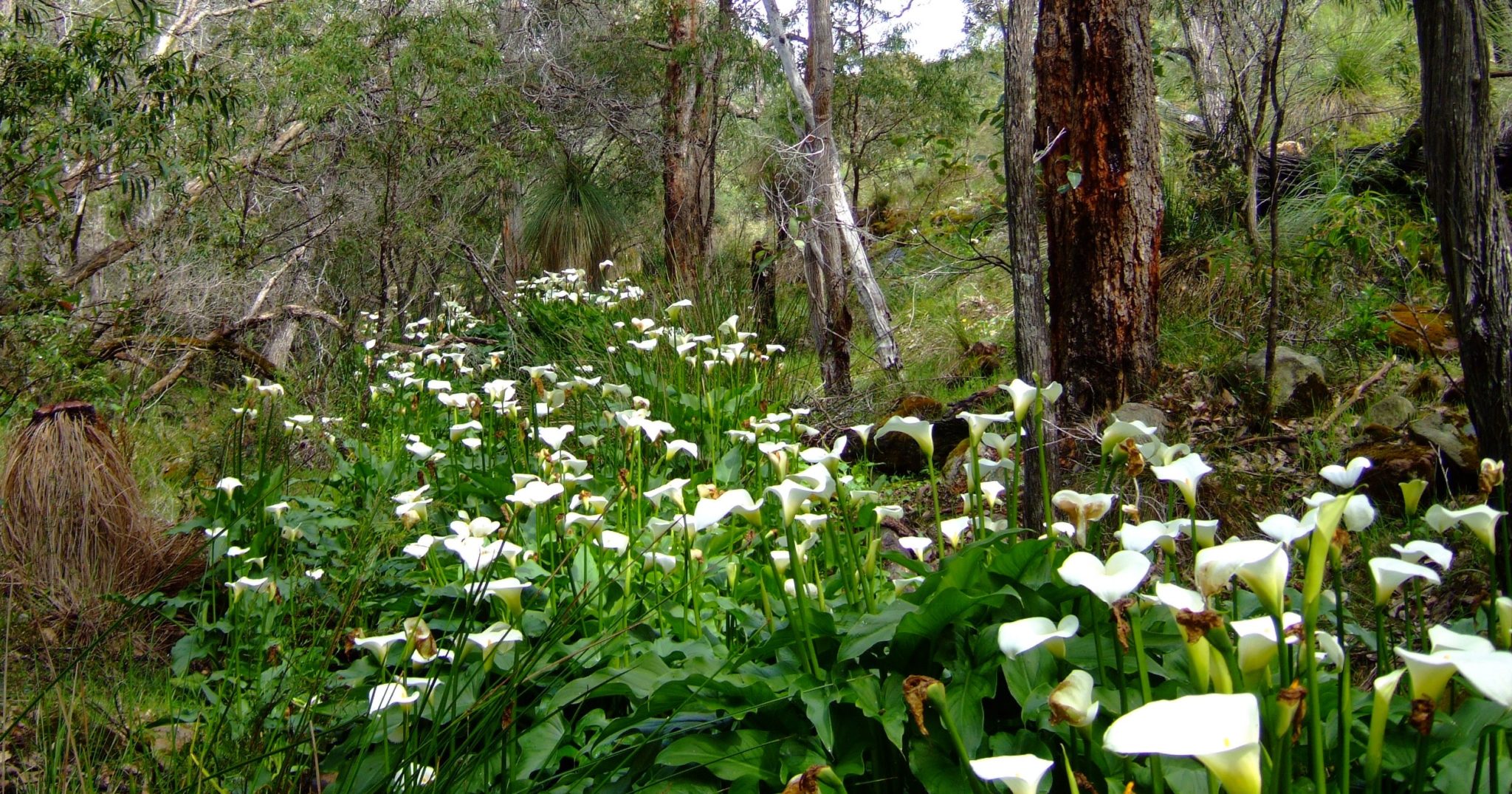
An arum lily infestation
The Blitz expanded its community insights this year by teaming up with the Behaviour Change Collaborative to run a major community survey on arum lily. More than 500 people responded, and the findings will guide a refreshed behaviour change strategy aimed at embedding arum lily control as an accepted social norm across the region.
Collaboration remained at the heart of the program, with targeted work in Boranup Forest undertaken alongside the Department of Biodiversity, Conservation and Attractions, the Shire of Augusta Margaret River and private landholders. The effort built on data from a 2024 mapping project to ensure on-ground control was directed where it would make the greatest impact.
Youth education also played a role. Through Nature Conservation’s Our Patch program, Year 3 students at Rapids Landing Primary School learned about arum lily, mapped infestations in the Wooditjup National Park trail network using the citizen science Fieldbook app, and took the message home to their families.
“We have the data to show what is possible when landholders, volunteers and public land managers pull together,” said Blitz coordinator Obelia Walker. “We owe it to our environment and to the community who have dedicated 6000 hours to arum lily control since 2019. Now we need to target those areas that are holding us back. We’ll be throwing everything at this over the next two years.”
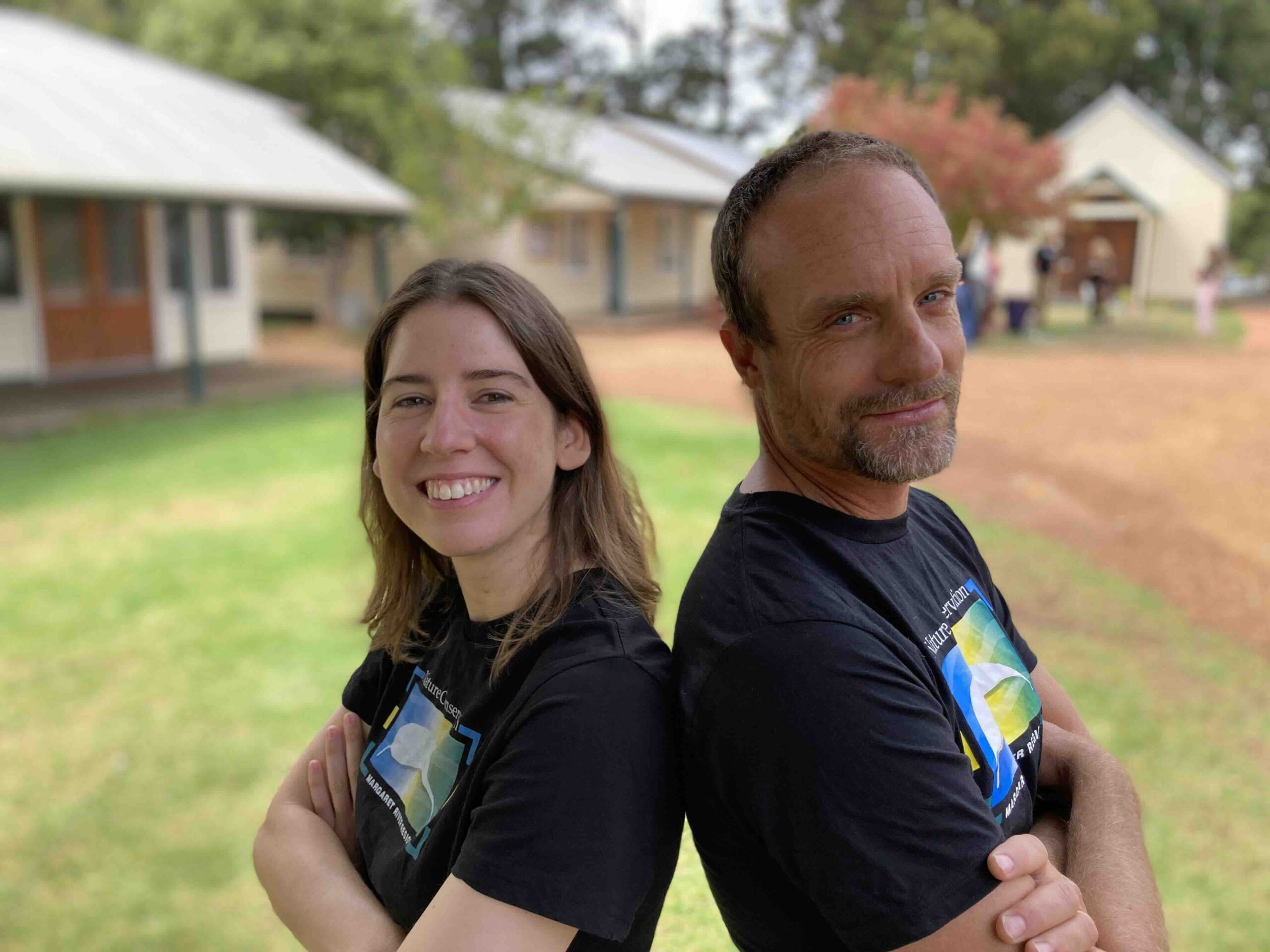
Arum Lily Blitz officers Obelia Walker and Ben Howell
Landholders and contractors came together at Fair Harvest Permaculture this week to celebrate another successful Blitz.
Since launching in 2019, the Arum Lily Blitz has now achieved:
- 2600 people registered with the Blitz across over 30,000 hectares, with hundreds of new landholders joining each year.
• Almost 2000 people collected free herbicide, with eight businesses from Busselton to Augusta helping with distribution.
• 760 reports submitted by landholders accounting for almost 6000 hours of arum lily control.
• At $50 per hour, that represents almost $300,000 of landholder effort. However, since we only receive 10% of landholder spray records back each year – we know that’s only a fraction of the work that occurs.
• 150 landholders supported on a cost-share basis in high-priority areas, involving 6200 hours of contractor work.
Nature Conservation CEO Aaron Jaggar said collaboration continued to be central to the Blitz’s momentum.
“Partnerships with the Friends of the Cape-to-Cape Track, Capes Foundation, Yallingup LCDC, Lower Blackwood Landcare, neighbouring shires and DBCA ensure arum lily remains front-and-centre as a regional priority,” he said. “It’s a collective effort that’s now being used as a model for weed control programs in four surrounding shires.”
Looking ahead to 2026, the Blitz will aim to ramp up its impact and:
• campaign for greater State Government support to target gaps and high-priority properties where control isn’t yet happening
• embed arum lily control as a social norm by implementing the revised behaviour change strategy
• boost engagement with wineries and growers, including organic operators
• run community blitzes and busy-bee style events to increase on-ground participation
For more information see www.natureconservation.org.au.